waltz jump
_edited.jpg)


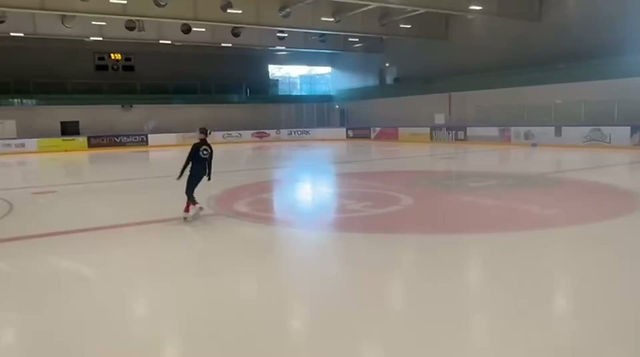
The three-turn jump (known in figure skating as the waltz jump) is the first introductory jump in figure skating, and often the very first real jump that skaters learn. The idea of this jump is to take off from the left foot and land on the right foot, or when jumping in the opposite direction, to take off from the right foot and land on the left foot.
The skater gains momentum on the ice, takes off, rotates half a turn in the air, and then lands safely on the opposite foot.
Salchow

The Salchow is one of the basic jumps in figure skating and belongs to the group of so-called edge jumps. This means that the skater does not use the toe pick of the skate to push off the ice, but instead generates the jump directly from the skating movement.
The skater approaches the jump while skating backward on an inside edge of one foot. As the body follows a curved path, the free leg swings in a wide, sweeping motion forward and upward. This powerful swing lifts the skater off the ice and simultaneously initiates the rotation in the air. After completing the rotation, the skater lands safely on the opposite foot, typically on an outside edge, and glides out backward. Because the movement flows smoothly into the jump, the Salchow often appears especially elegant and dynamic.
Toeloop
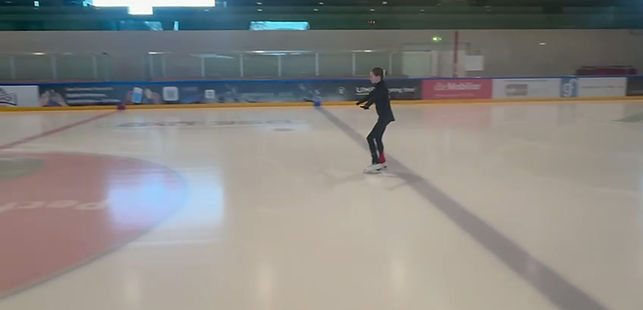
The Toe Loop is one of the most frequently performed jumps in figure skating and belongs to the category of toe jumps. Unlike the Salchow, the skater uses the toe pick of the blade to push off the ice.
The approach is usually done while skating backward on an outside edge. While keeping the weight on the skating foot, the skater lightly taps the ice behind with the toe pick of the free foot. This quick and powerful tap acts like a springboard and launches the skater upward into the rotation. Because the takeoff is very stable due to the toe pick assist, the Toe Loop is often used as the second jump in jump combinations. The landing is smooth and controlled, typically backward on the outside edge of the same foot that performed the toe pick takeoff.
loop
The Loop Jump (Rittberger) belongs, like the Salchow, to the group of edge jumps, but it is performed without a large leg swing. The skater approaches the jump while skating backward on the outside edge of the skating foot.
What makes this jump special is the body position just before takeoff: the free leg is crossed in front of the skating leg, creating a tight, spring-like position. Since there is no toe pick assist, all the power for the jump comes from the knee and hip of the skating leg, combined with a slight rotational motion of the upper body. The skater then pushes directly off the outside edge into the air, rotates around the body axis, and lands again on the same outside edge that was used for takeoff.
Because of this technique, the Loop Jump feels very rhythmic and controlled, and it is frequently used in competitions as the second or third jump in jump combinations, often directly connected to another jump.

Flip

The Flip is a figure skating jump where the skater usually approaches backward on the inside edge of one skate. While maintaining this curved edge, the skater firmly taps the ice with the toe pick of the other foot behind them to launch into the air.
This takeoff is crucial: the jump is initiated from an inside edge position, assisted by the toe pick. In the air, the skater rotates the body before landing backward on the outside edge of the opposite foot, as in most jumps.
What makes the Flip special is the combination of a stable inside edge and an explosive toe pick assist, which gives the jump a powerful and dynamic appearance.
Lutz

What makes the Lutz special is that, unlike almost all other jumps, it is performed on the “wrong side,” meaning against the natural direction of rotation. While most jumps use the curve of the edge to enter the rotation, the Lutz is skated on a backward outside edge that actually moves in the opposite direction of the intended rotation.
This means that at the moment of takeoff, the skater must use the toe pick to overcome the resistance of the original skating direction in order to force the body into the correct rotation. This counter-rotation is what makes the Lutz so technically demanding and creates its distinctive appearance: a long, wide outside curve is held first, before the skater suddenly takes off inward into the jump.
Axel

The Axel is the only jump in figure skating that takes off while moving forward, which makes it the easiest jump for spectators to recognize. However, since all jumps in figure skating land backward, the Axel has a special feature: it always includes an extra half rotation compared to other jumps. A single Axel therefore consists of one and a half rotations.
The skater usually approaches the jump in a wide backward curve, but just before takeoff switches to a forward outside edge on the left foot (for right-handed skaters). At the moment of takeoff, the free leg swings powerfully forward and upward, almost as if stepping onto an invisible stair. This forward swing gives the jump its height and distance.
In the air, the skater rotates one and a half, two and a half, or even three and a half turns before landing smoothly backward on the outside edge of the opposite foot. Because of the extra half rotation and the forward takeoff, the Axel is considered the most technically difficult and prestigious jump in figure skating.
Spins
The Upright Spin (Stand Spin)
The upright spin is the foundation of basic figure skating technique and appears especially clean and elegant due to its straight, vertical body position. In this spin, the skater rotates on one foot while the free leg is usually held relaxed next to the skating leg. A more advanced variation is the layback spin, where the skater bends the upper body far backward or sideways, requiring extreme flexibility in the back. Often the head is positioned almost parallel to the ice while the arms are held gracefully above the body. Another variation is the crossed-leg spin, where the legs are crossed during rotation. This tight body position reduces the rotational radius, which significantly increases spin speed, creating a visually striking “whirling” effect.
The Sit Spin (Sitzpirouette)
The sit spin demands enormous leg strength, as it is essentially a one-legged squat performed during fast rotation. The hips must be at least at knee level for the element to be valid in competition. The free leg is usually extended forward, requiring strong full-body tension. More difficult variations include the broken-leg position, where the upper body folds over the skating leg, creating a compact, folded shape. Another variation involves the free leg being pulled behind or to the side of the body, shifting the center of gravity and making balance significantly more difficult on the narrow blade.
The Camel Spin (Waagepirouette)
In the camel spin, the skater’s body forms a horizontal line almost parallel to the ice. The skating leg remains extended while the free leg and upper body stretch backward in a straight line, creating a T-shaped silhouette. This spin is particularly challenging due to the long lever created by the extended free leg, which makes balance difficult. One of the most difficult variations is the donut spin, where the skater grabs the blade of the free leg behind the back and pulls it toward the head, forming a closed circular shape. This requires exceptional flexibility in the hips and spine.
The Biellmann Spin
The Biellmann spin is considered the ultimate showcase of flexibility and is technically an extreme variation of the upright spin. The skater pulls the free leg upward behind the head using both hands, creating a teardrop-shaped position. Only a small number of athletes have the required shoulder and back flexibility to maintain this position over multiple rotations. Due to its difficulty and physical demand, it is often regarded as one of the most challenging spin elements and earns high scores in competition.
(no Video Material)
The Jump Spin (Sprungpirouette)
The jump spin combines the explosive power of a jump with the precision of a spin. The skater takes off forcefully from the ice, performs a short flight phase, and lands directly into a defined spin position. A well-known example is the flying sit spin, where the skater is almost horizontal in the air before landing deeply into a sit spin. Since the landing must immediately transition into rotation, timing is crucial. Even a slight mistake can destroy the spin’s momentum or cause a fall. These elements are often used at the beginning of programs to create a dynamic and energetic opening.
(no Video Material)


